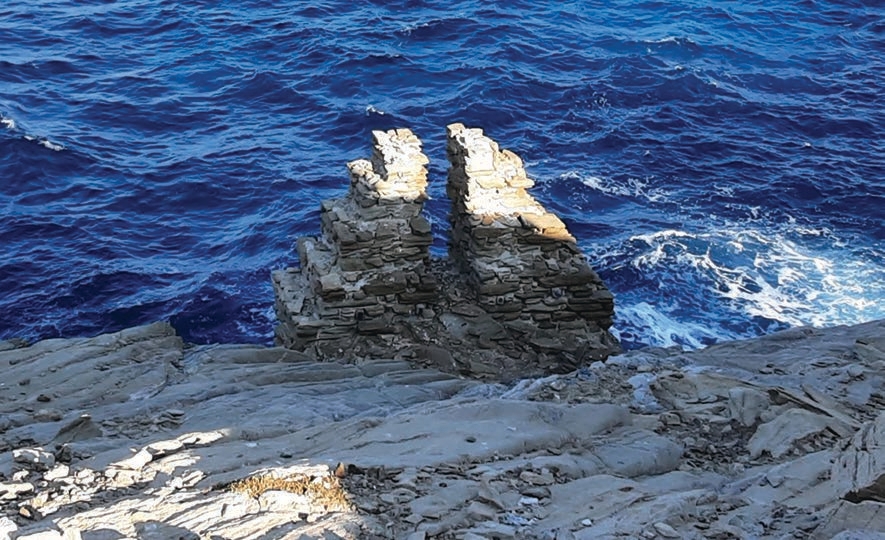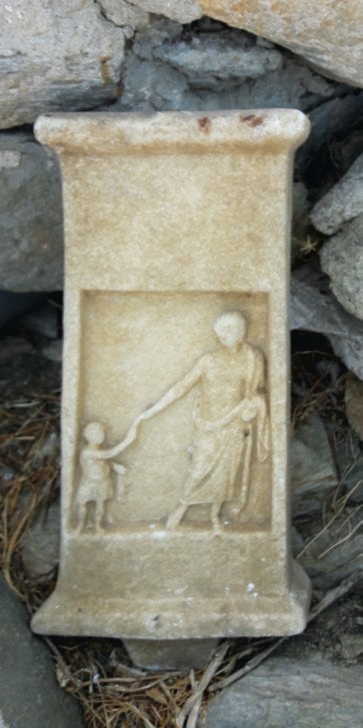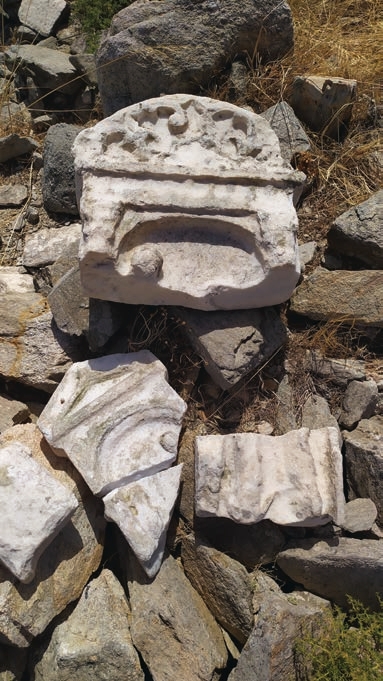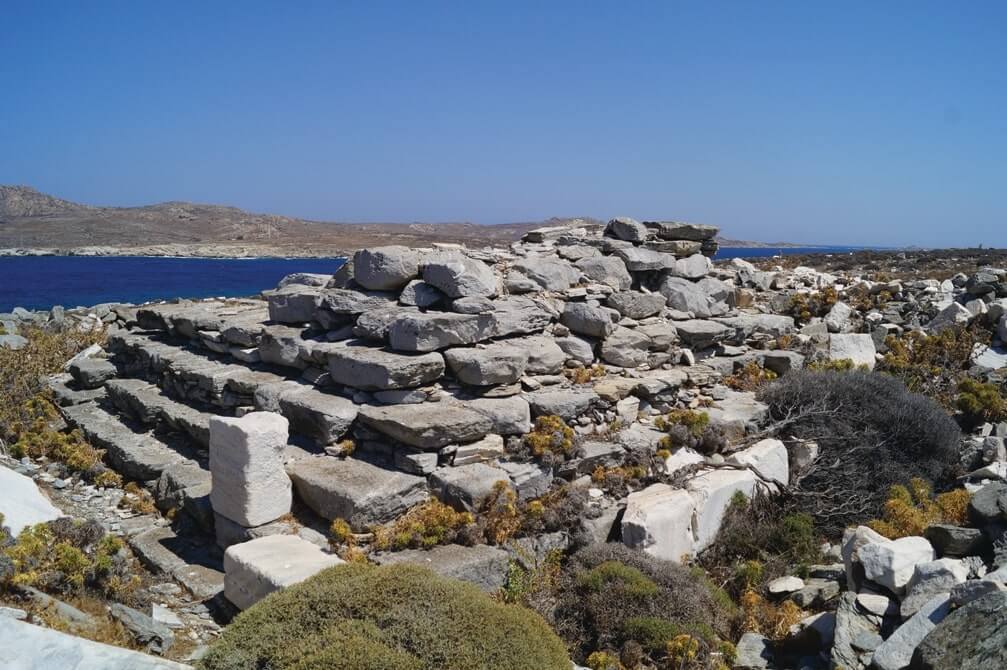
Stepped monument at the northern end of the Delian necropolis in Rhenia.
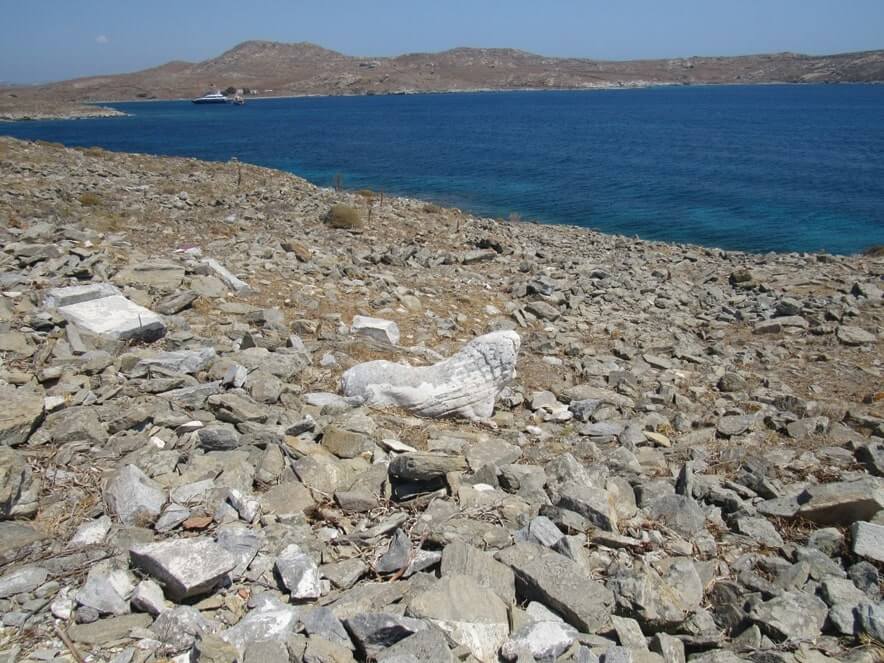
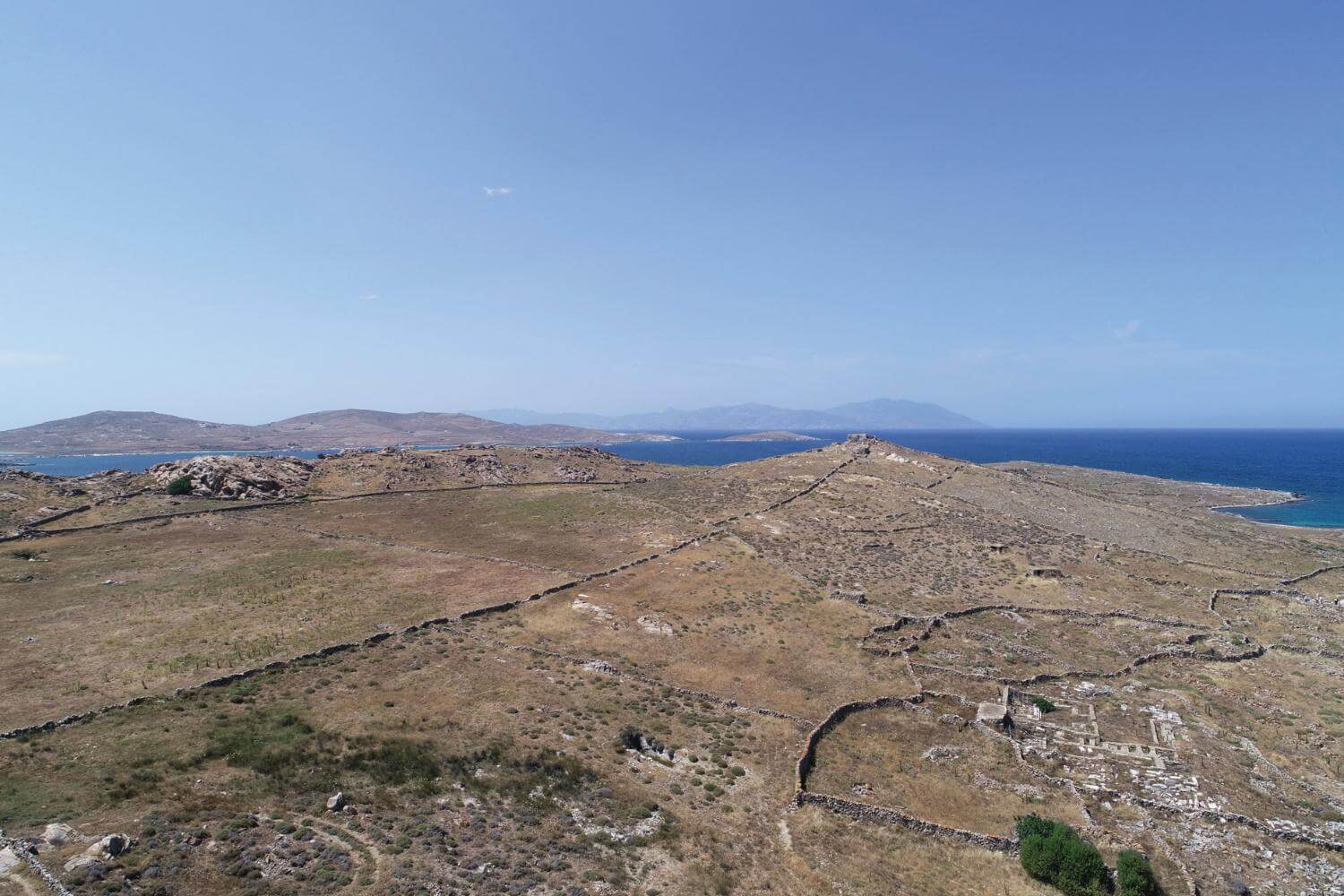
Rineia (the “Great Delos” for present-day Mykonians) is identified with the island of Ortygia where, according to the Homeric Hymn to Apollo, Artemis was born. After part of Rineia was granted to the sanctuary of Delian Apollo by the Samian tyrant Polycrates in the 6th century BC, a section of the island came under the territory of Delos and functioned as the burial and birthplace of the Delians, especially after the second purification carried out by the Athenians in 426/5 BC on the sacred island.
In addition to the impressive Delian cemetery and the ten agricultural estates belonging to the Delian sanctuary of Apollo on Rineia, there were also two Delian sanctuaries there: one dedicated to Artemis—among the most important within the Delian territory—and another to Dionysus.
On the northwestern side of the island (in today’s “Epanō Deles”) lies the ancient city of Rineia, with its cemeteries and sanctuaries. On the northeastern coast, the ruins of the “Delos quarantine station” are also preserved, a site visited in 1901 by C. P. Cavafy during his first journey to Greece.
Today, Rineia is divided into “partides,” that is, agricultural plots leased by Mykonians, and largely retains its predominantly agro-pastoral character shaped over many centuries. Since 2019, the Ephorate of Antiquities of the Cyclades has been conducting an intensive surface survey on the island in order to document the full extent of its numerous visible remains and structures over time. The aim is both their institutional protection and the investigation of key historical questions concerning the relationship between Delos and Rineia and the role of the latter in the history of the Aegean.
The systematic archaeological field research conducted by the Ephorate of Antiquities of the Cyclades on the island of Rineia continued with significant results in 2023 and 2024.
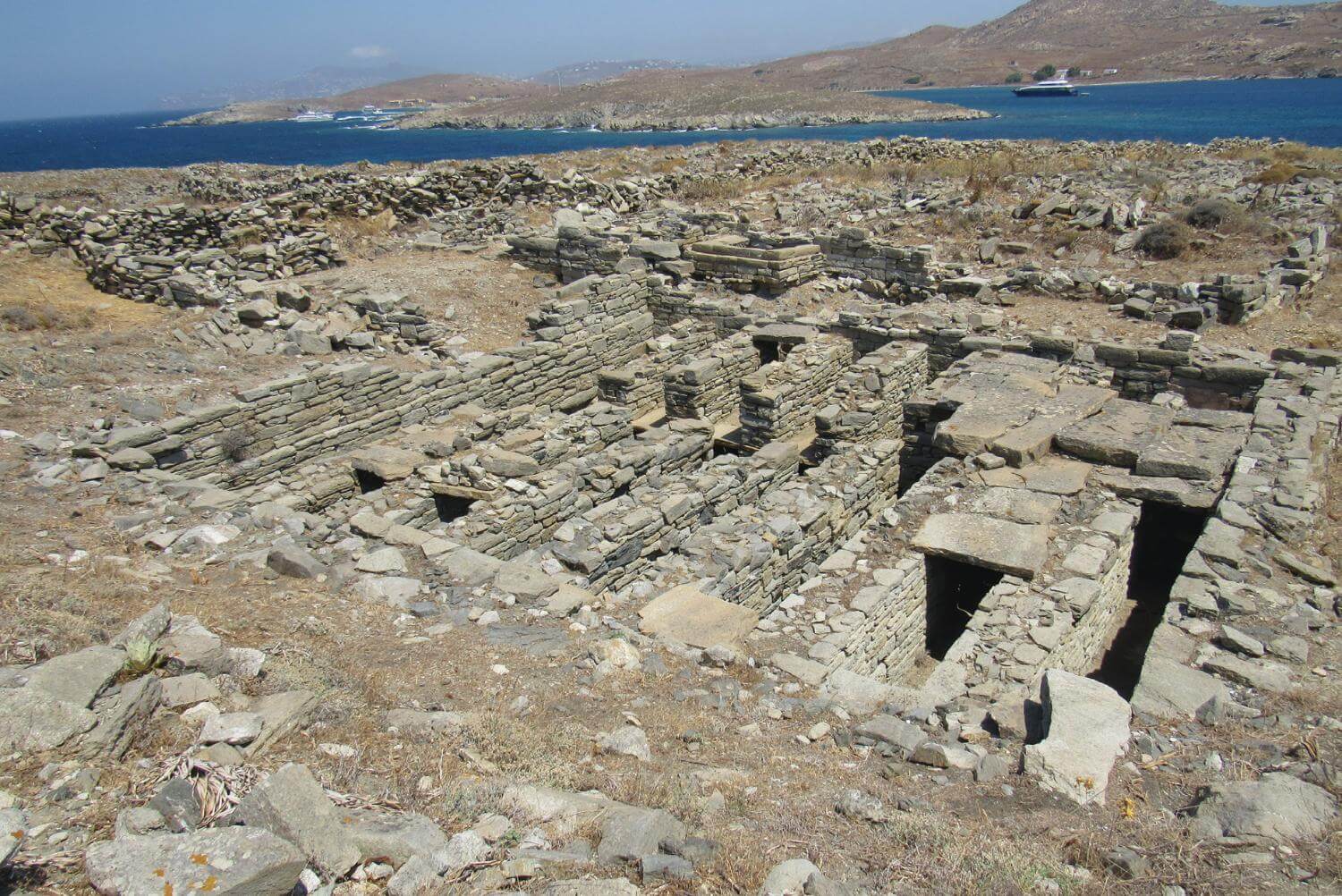
The research programme, carried out in collaboration with the French School at Athens as well as Greek and international universities, focused on the northwestern part of the island, in the wider area of the ancient city of Rineia. In addition to numerous settlement remains, the locations of three cemeteries were identified, along with coastal installations in the bays of Ampelia and Kormos, to the north and south of the ancient city respectively.
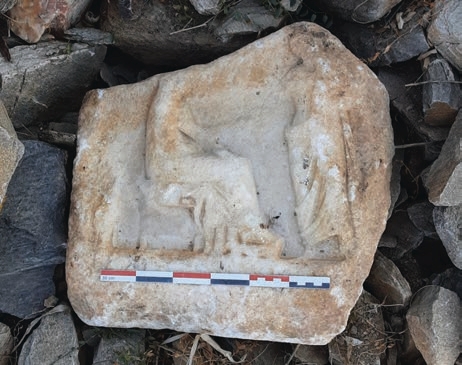
At the same time, all later constructions were documented, as well as several sites of post-medieval mining activity. Significant progress was also made in the investigation of the Delian necropolis, at the southwestern tip of Rineia, where the recording of visible remains was completed as far as the southeasternmost point of the island. At the site of Marmarokopio, the remains of an impressive all-marble structure were recorded, which is believed to have functioned as a lighthouse.
The aim of the Ephorate of Antiquities of the Cyclades’ field research is the comprehensive recording of human-made remains, the understanding of diachronic land use on Rineia—from prehistory to the modern era—and the investigation of the island’s role in the history of the Aegean. Particular emphasis is placed on the study of its complex and long-standing relationship with neighbouring, emblematic Delos.
Image source: Ephorate of Antiquities of Cyclades Archive