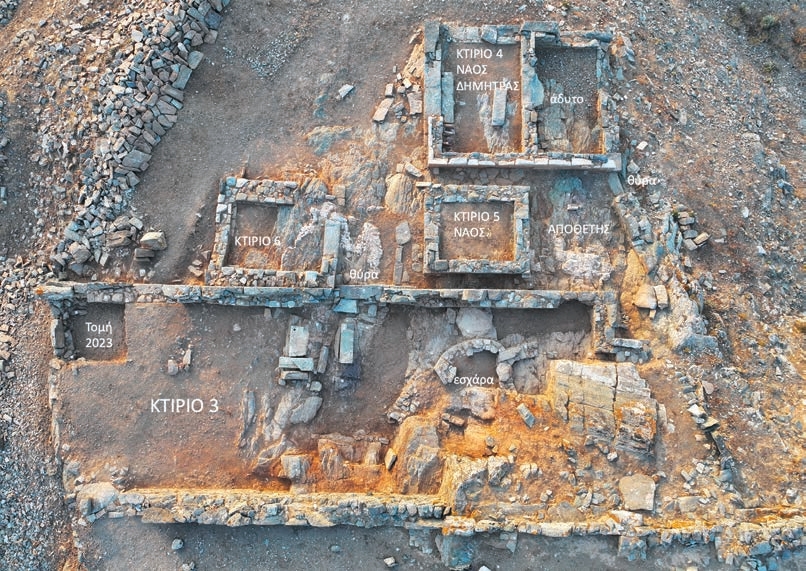
Aerial photograph of the Sanctuary of Demeter and Kore.
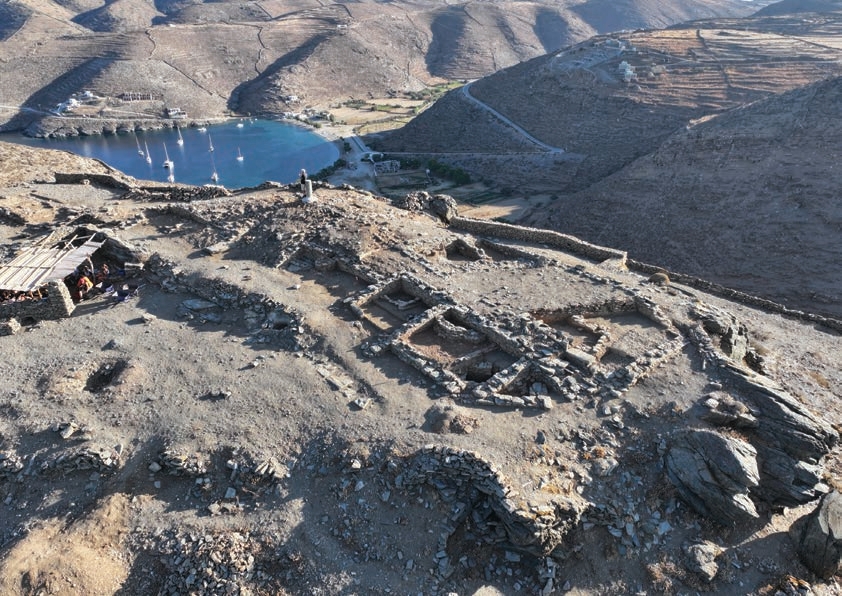
The university excavation at the “Vryokastro” site and on the islet of “Vryokastraki,” on Kythnos, began in 2002 under the direction of the Sector of Archaeology of the Department of History, Archaeology and Social Anthropology of the University of Thessaly, in collaboration with the Ephorate of Antiquities of the Cyclades. The research team is headed by Professor Alexandros Mazarakis-Ainian. Since 2018, Dr Dimitris Athanasoulis has served as co-director of the research, while Dr Dimitris Kourkoumelis was co-director of the underwater excavation on behalf of the Ephorate of Underwater Antiquities.
The site is identified with the ancient city of Kythnos, which was inhabited from the 12th century BC until the 6th–7th century AD. Excavations to date in the Upper City have brought to light sanctuaries dating to the Archaic, Classical, Hellenistic, and Roman periods. In the same area, the Hellenistic prytaneion of the city was also excavated.
Since 2021, the excavation has focused on the ancient Acropolis, following the acquisition of properties by AIGEA AMKE on behalf of the Greek State. A significant sanctuary had already been identified there during the surface survey of 1990 and was systematically investigated between 2021 and 2024. As indicated by inscriptions incised on ritual drinking vessels, the sanctuary was dedicated to Demeter and Kore.
Two temples, as well as an elongated ritual building, were excavated. The votive offerings were countless, consisting mainly of clay figurines depicting women, children, and animals, clay lamps, and multi-nozzled ritual lighting vessels. Large quantities of exceptionally fine pottery were also found, along with numerous metal, glass, and marble objects.
On the southern side of the acropolis plateau, an extensive residential complex is being excavated, dating from the Early Iron Age (10th–8th century BC) to the Hellenistic period.
This complex, together with Vryokastraki, appears to represent the early core of habitation of the ancient city. It seems that the city’s military garrison was stationed here, along with their families.