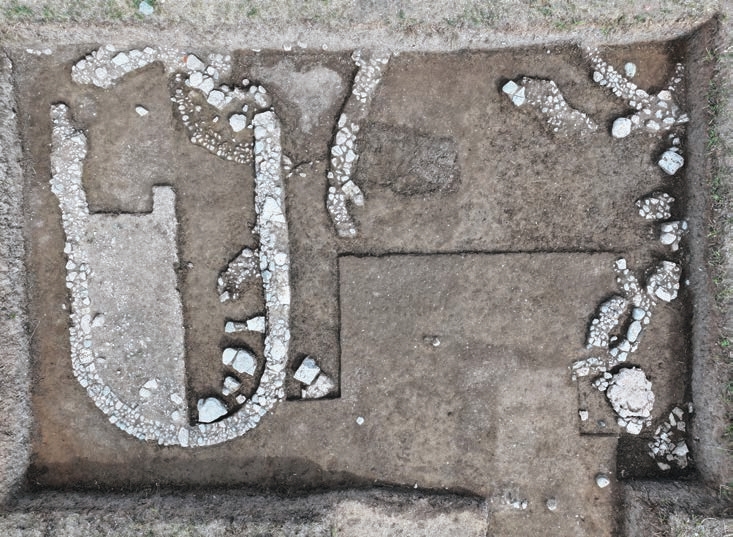
The trench with Buildings MB (left), MD (on the northeast side of MB), and ME (at the northeast corner).
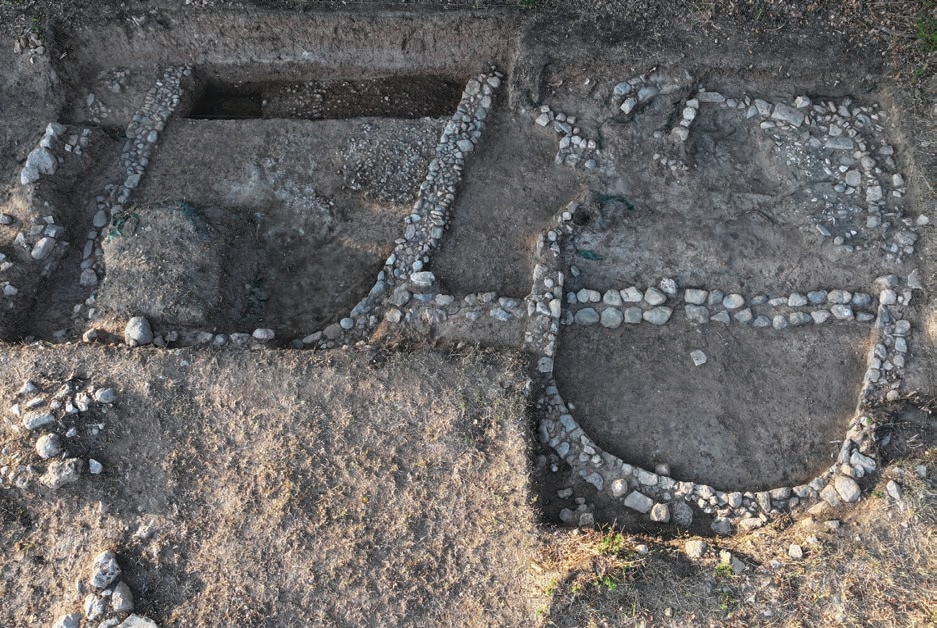
In 2023 and 2024, the excavation of the Early Historic settlement at Skala Oropou in Attica was resumed under the auspices of the Archaeological Society and the direction of Professor A. Mazarakis-Ainian, following earlier campaigns conducted between 1985 and 2011. It is one of the most extensive and best-preserved settlements in mainland Greece dating to the second half of the 8th century BC, and is most likely identified with the Homeric “Graia” (Iliad, B 498).
The new excavation was confined to the so-called “Western Sector.” At the western end of the large trench, the investigation of the elliptical buildings LTH and M/MA was completed. The excavation data showed that building M/MA remained a landmark after its abandonment, its location still visible, likely covered by a low tumulus. The excavation of the spacious elliptical building LTH, one of the oldest in the settlement, was also completed.
To the east of these buildings, another elliptical structure (MB) dating to the second half of the 8th century BC was brought to light, along with fragmentarily preserved remains, including two additional curvilinear buildings (MG and MD). Inside building MB, which was identified as a dwelling, two hearths were found. Among the finds were a fragment of an iron spit and a bronze cheese grater, indicative of household activities. Of particular interest was the discovery, within the abandonment layer of MB, of three infant jar burials (enchytrismoi). The vessels date to the late 8th century BC but were reused for the burial of the infants in a later period.
In addition to the excavation and research programme, AIGEA AMKE also funded the preliminary study for the protection and enhancement of the antiquities of the “Central Sector” (excavations 1985–87, 1996–2003), which is currently under review by the Ministry of Culture.
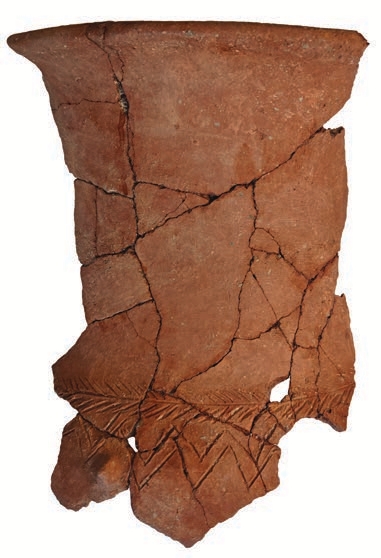
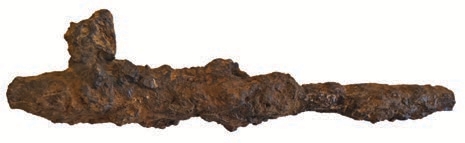
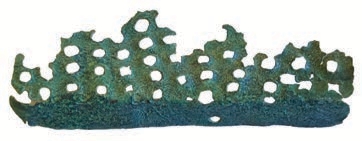
Fragments of a bronze cheese grater and an iron spit
Image source: Archive of A. Mazarakis-Ainian