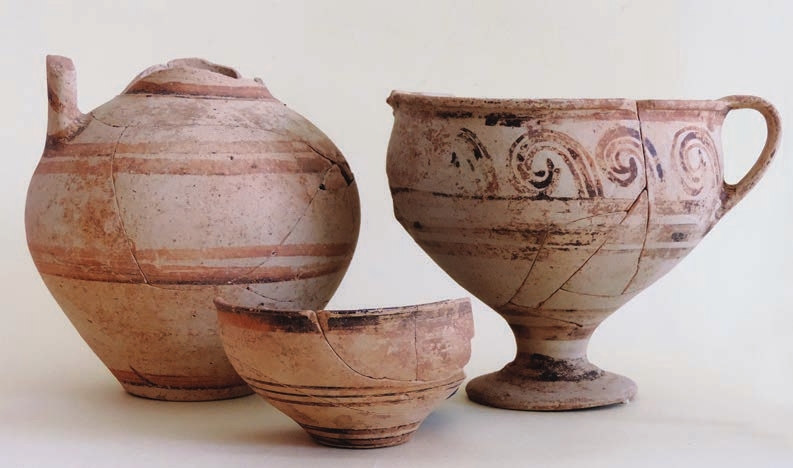
Mycenaean pottery from the “House of the Bronzes.”
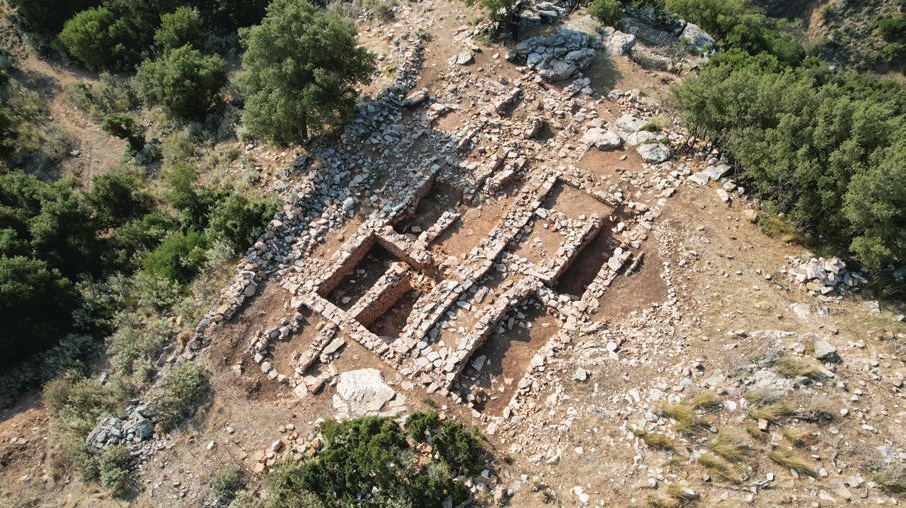
The settlement of Mygdalia at Petrotó was founded in the 16th century BC, southeast of the present-day city of Patras. Systematic excavation began in 2008 under the direction of Dr Lena Papazoglou Manioudaki and Dr Kostas Paschalidis, and continues to the present day under the supervision of the Ephorate of Antiquities of Achaia.
The settlement, which developed into an important local centre during the early Mycenaean period, remained inhabited until the 12th century BC. Many centuries after its abandonment, around 700 BC, a sanctuary was founded on the same site.
The settlement is built on three levels. Its most important building was constructed in the 15th century BC and remained in use until the end of the 14th century BC (LH II–IIIA1 period). It is a large two-storey structure with massive walls, a basement, and an elevated ground floor. With a total surface area of 220 sq m per floor, it constitutes the largest building of the Mycenaean world in northwestern Peloponnese.
In one of the ground-floor rooms, the famous Mygdalia hoard was discovered, a group of hundreds of bronze and other small finds. The construction of the Mygdalia tholos tomb also dates to the same period; it most likely belonged to members of the lineage that occupied this building, which is also known as the “House of the Bronzes,” named after its remarkable finds.
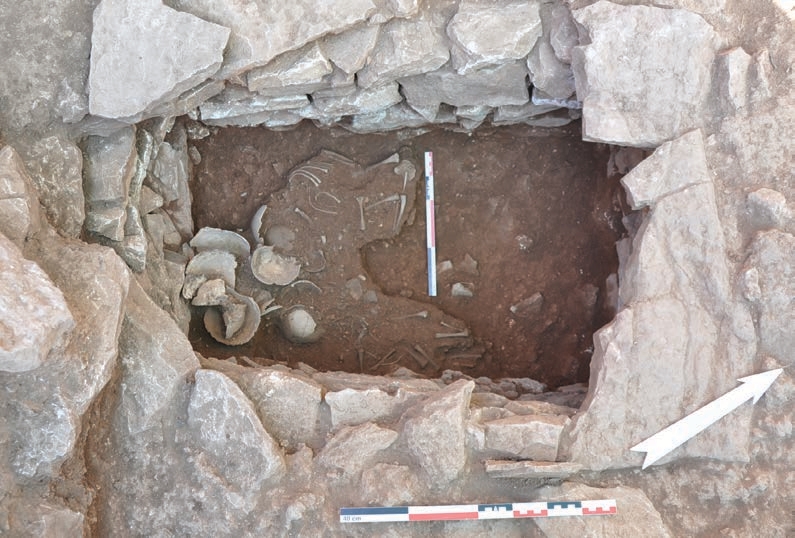
One of the most intriguing discoveries at Mygdalia is the infant burials found בתוך the houses of the settlement. To date, seven graves have been identified. They are usually undisturbed, without grave goods, and belong to newborn infants. Osteological analyses have shown that the newborns died during childbirth or before reaching forty days of life.
Furthermore, DNA and bone collagen analyses revealed that seven infants from the same grave were cousins, as their fathers were brothers.
Image credit: L. Papazoglou-Manioudaki and K. Paschalidis.