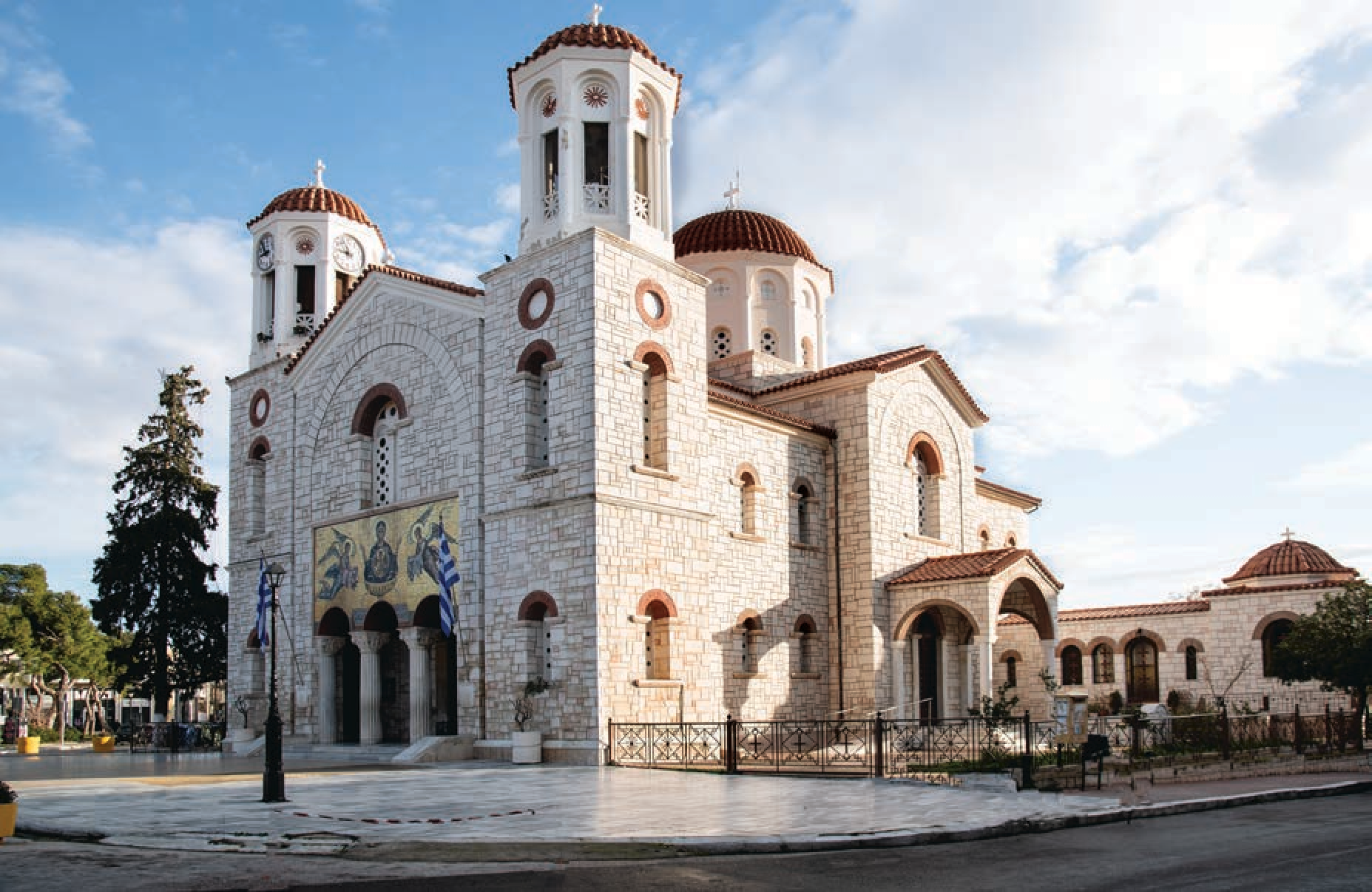
Holy Church of Zoodochos Pigi
Donation Receiver:
Holy Church of Zoodochos Pigi
Sector:
Religion
Implementation Body:
AEGEAS Non-Profit Civil Company
Year:
2024
Location:
Paiania, Attica
The Church of Zoodochos Pigi is located in the central square of Paiania. Its construction is directly linked to the development of the settlement in the early 20th century, when Liopesi—as Paiania was known until 1915—began to expand, gain autonomy as a community, and undergo urbanization.
The construction of the church forms part of this transition, with its design dating back to the late 19th century.
In 1902, the first reconstruction works began, based on designs by the engineer M. Lykoudis. The church belongs to the type of the three-aisled domed basilica and incorporates neoclassical elements. Its marble iconostasis was constructed in 1907 by the sculptor Karakatsanis, while shortly thereafter the painter Augustos Pikarellis created its Nazarene-style icons. The church was inaugurated in the spring of 1908.
A particularly interesting aspect of the church’s history is the contribution of Ernst Ziller, who in 1915 prepared a restoration study for the dome and the roof, which were facing structural problems. Following various extensions, the church acquired its present form in 1939, while in 1981 it underwent a major intervention with the addition of a stone facing.
The systematic iconographic decoration of the church began in 1939 by Photis Kontoglou and his students, Giorgos Gialtas and Ioannis Terzis. It was, in fact, the first parish church undertaken by the great painter. After an interruption due to the Occupation, the iconographic work resumed in stages from 1946 until 1965, the year of Kontoglou’s death. His work was continued by his collaborator Vasileios Brousalis, who had already been working in the church since 1959, and was completed during the 1970s.
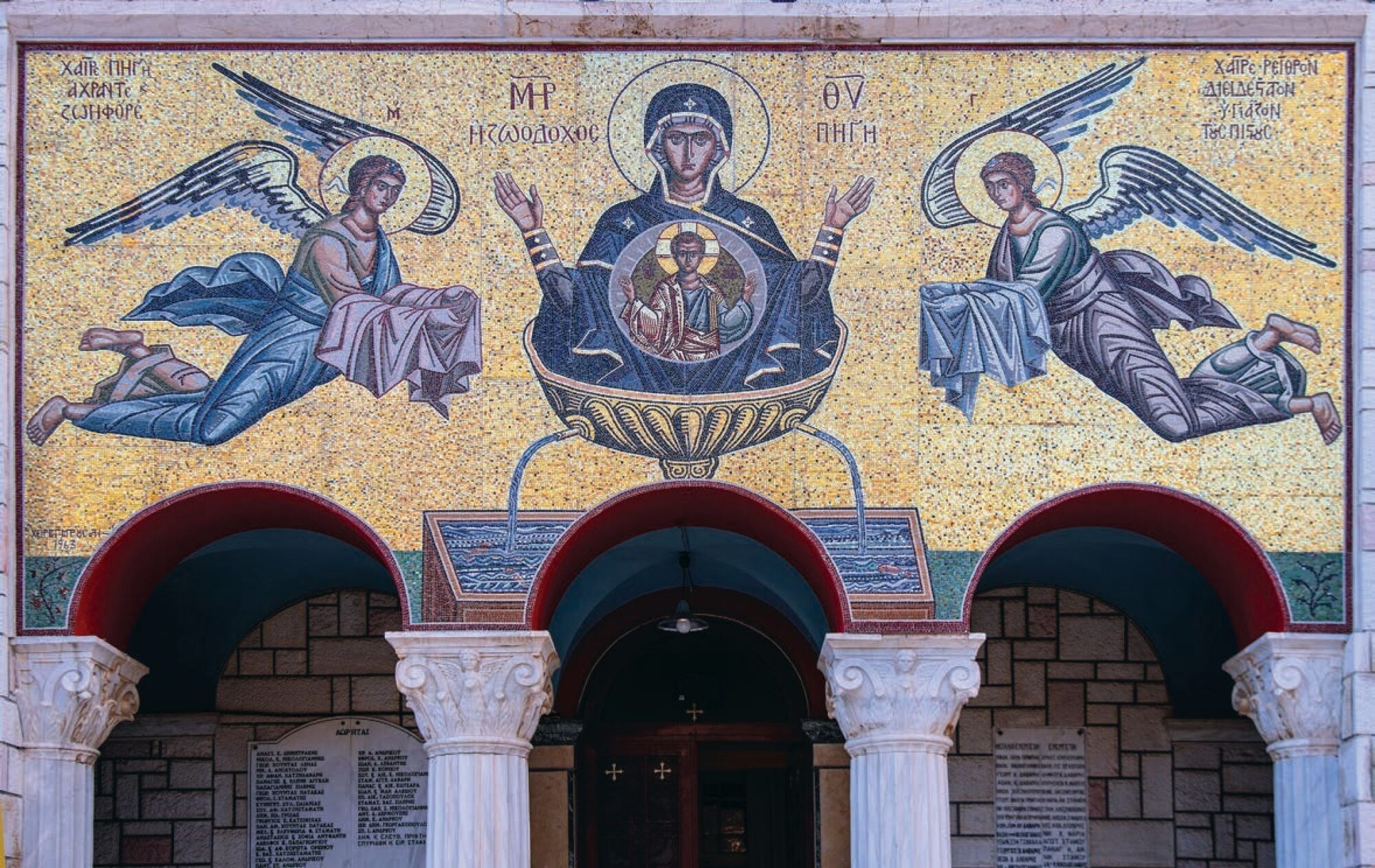
One of the most impressive features of the church is the mosaic of the Life-Giving Spring, which adorns its western façade. It was created in 1963 by Vasileios Brousalis, using tesserae imported from Murano, Italy.
Recognizing the importance of the church both as a symbol of the collective memory of the local community and as a historical and artistic monument—owing in particular to the presence of Photis Kontoglou—AEGEAS AMKE undertook, through its donations, conservation and restoration works, as well as the preservation of the mosaic on its façade.
DONATION OF THE NON-PROFIT CIVIL COMPANY AEGEAS
- Restoration of the roof and conservation of the mosaic on the façade of the church.
Photographs: Maria Stefosi.